RoDTEP — What It Is, What Just Changed, And What You Must Do Before 31 March

DGFT · EXPORT COMPLIANCE · MARCH 2026
A complete practitioner's guide to the scheme, the 50% rate cut, the Annual Return deadline, and the restrictions — explained without the jargon.
On 23 February 2026, the government halved RoDTEP rates across the board. No warning. No transition period. No grandfathering for shipments already contracted.
Every exporter outside agriculture woke up that morning with a margin gap they had not planned for. Industry bodies called it a shock. Rollback representations have been filed. The debate is loud.
But while that debate continues — there is a compliance deadline 25 days from today.
Before getting to the urgency, let me first explain what RoDTEP actually is.
What is RoDTEP — and why does it exist?
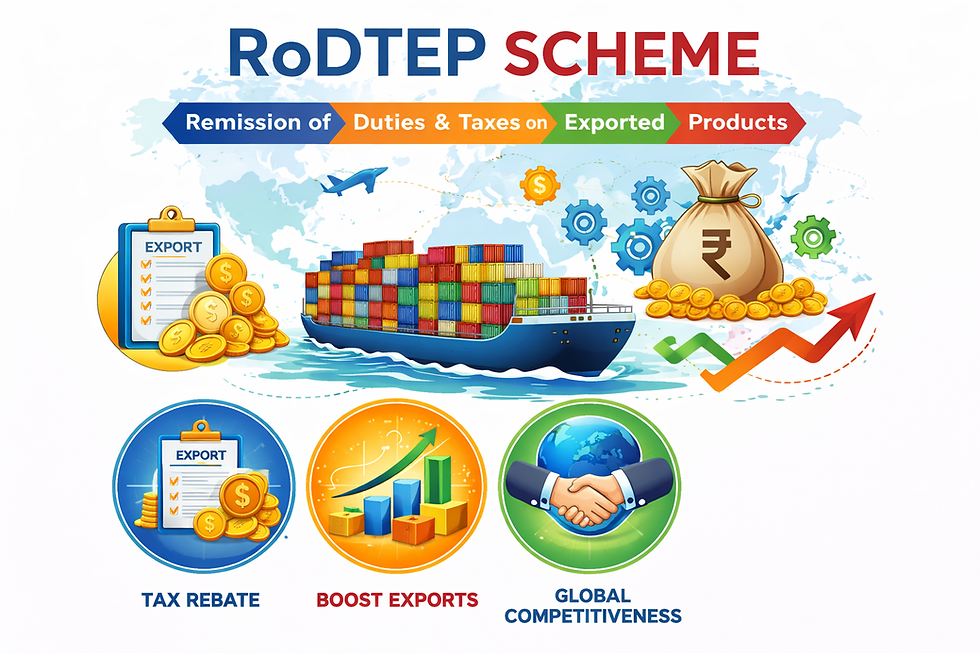
RoDTEP stands for Remission of Duties and Taxes on Exported Products.
India's previous flagship export incentive — MEIS (Merchandise Exports from India Scheme) — was successfully challenged at the WTO by the United States as an impermissible export subsidy. India lost in Oct 2019. MEIS had to be discontinued
RoDTEP was designed as its WTO-compliant replacement. The fundamental difference: RoDTEP is not an incentive. It is a remission/refund of embedded taxes and duties that exporters pay during manufacture and distribution but cannot otherwise recover through any other scheme.
The taxes it covers include:
▸ Mandi taxes and state levies on inputs
▸ VAT on fuel used in transportation and production
▸ Electricity duties on power consumed in manufacturing
▸ Coal cess embedded in production costs
▸ Stamp duty on export documents
▸ Central and state taxes not refunded under GST or Customs
The benefit is issued as a transferable electronic duty credit scrip (e-scrip) — credited directly to an electronic ledger on the ICEGATE portal. Rates range from 0.01% to 4.3% of FOB value, product-specific, across approx. 8500 HS lines in Appendix 4R/ 4RE of Handbook of Procedure (HBP) 2023.
How to utilise your RoDTEP scrips?
Once generated on ICEGATE, here is how the scrip works:
Use the scrip ONLY for payment of Basic Customs Duty (BCD) on imports
Cannot be used for IGST, Compensation Cess, or Anti-Dumping Duty
Freely transferable — sell or transfer to any other importer if you have no import requirements
Scrips carry a validity period — monitor expiry dates actively; expired scrips cannot be revived
The practical rule - Scrips have a secondary market – sell them before they expire
RODTEP Timeline
Date / Period | Event | Reference |
1 Jan 2021 | Scheme comes into effect | DGFT Notification |
17 Aug 2021 | RoDTEP rates formally notified for in Appendix 4R — backdated to 1 Jan 2021. AA/EOU/SEZ EXCLUDED at this stage | Notification 19/2015-20 |
2021 | First RoDTEP Committee constituted under former Home & Commerce Secretary G.K. Pillai to recommend rates | MoCI order |
11 Mar 2024 | RoDTEP extended to AA holders (except Deemed Exports) and EOU units at lower rates via Appendix 4RE — first time AA included | Notification 70/2023 |
Sep 2024 | Rates revised and scheme extended to 30 Sep 2025 for DTA; AA/EOU/SEZ till 31 Dec 2024 | Notification 32/2024-25 |
23 Oct 2024 | Annual RoDTEP Return (ARR) introduced — mandatory for exporters with >₹1 crore RoDTEP claim in FY 2023-24 | Public Notice 27/2024-25 |
Feb 2025 | RoDTEP for AA/EOU/SEZ lapses — gap period begins | — |
1 Jun 2025 | RoDTEP reinstated for AA/EOU/SEZ exporters | Notification 11/2025-26 |
30 Sep 2025 | Scheme extended for DTA, AA, EOU, SEZ till 31 Mar 2026 | Notification 35/2025 |
Oct 2025 | Second RoDTEP Committee under Mr. Neeraj Kumar Gupta constituted to review and revise rates — report due 31 Mar 2026 | MoCI order |
5 Feb 2026 | ARR deadline extended to 31 Mar 2026 — composition fee of ₹15,000 for late filers | Public Notice 46/2025-26 |
23 and 24 Feb 2026 | DGFT cuts RoDTEP rates to 50% of existing rates — immediate effect, all HS codes except Ch. 01–24 | Notification 60/2025-26 and Corrigendum to 60/2025-26 |
What just happened — the 50% rate cut explained
DGFT Notification No. 60/2025-26 dated 23 February 2026 restricted RoDTEP rates for all HS lines in Appendix 4R and 4RE to 50% of existing notified rates with immediate effect. Value caps, wherever prescribed, are also halved.
The corrigendum the following day carved out one important exemption: exports under ITC HS Chapters 01 to 24 — agriculture and allied products — retain their original rates. Everything else: halved, from the date of notification, on every shipping bill filed thereafter.
The cut has landed while the second RoDTEP Committee review is still ongoing — which is the precise point that has caused industry outrage. Industry has argued that cutting rates mid-review contradicts the purpose of commissioning a committee in the first place. Representations for reinstatement of original rates until the committee reports are being actively filed by EPCs.
The government's framework position, as embedded in Para 4.54 of FTP 2023, is clear: RoDTEP operates within a budgetary ceiling and adjustments shall be made as required to stay within that ceiling. Budget 2026-27 reduced the RoDTEP allocation significantly. The rate cut follows.
The AA restriction — what the scheme does and does not allow
This is one of the most misunderstood aspects of RoDTEP — and getting it wrong has direct compliance consequences.
"RoDTEP cannot offset what another scheme has already exempted. The principle is simple: one embedded cost, one remission."
When RoDTEP rates were first notified in August 2021, Advance Authorisation (AA) holders, EOU units, and SEZ units were entirely excluded from the scheme. The reason: AA holders already import duty-free inputs under the AA framework — there is no embedded customs duty on those inputs to remit.
In March 2024, the government included AA holders and EOU units via a separate Appendix 4RE — at lower rates than the DTA Appendix 4R, reflecting the fact that only a subset of embedded costs apply to these exporters.
The current position — verified from FTP 2023 and DGFT notifications — is:
Category of Exporter | RoDTEP Available? | Rate Schedule | Key Restriction |
DTA units (standard exporters) | Yes | Appendix 4R | Full rates — no restriction |
AA holders (except Deemed Exports) | Yes — but restricted | Appendix 4RE | RoDTEP available only on domestic input costs. NOT available on the duty-free imported inputs under AA. No double benefit. |
EOU units | Yes — but restricted | Appendix 4RE | Same as AA holders — only on domestic input embedded taxes |
SEZ units | Yes — but restricted also subject to ICEGATE integration | Appendix 4RE | Same restriction on duty-free inputs |
AA holders — Deemed Exports, MOOWR units, Exports from Non-EDI ports, etc | NOT available | — | Explicitly excluded — Para 4.55 of FTP 2023 |
The practical rule: if a specific embedded cost has already been offset by duty-free import under AA — RoDTEP cannot be claimed on that same cost. Maintain clear cost segregation between domestic input costs and duty-free import costs in your records.
The Annual RoDTEP Return (ARR) — everything you need to know
In October 2024, DGFT inserted Para 4.94 into the Handbook of Procedures 2023 via Public Notice No. 27/2024-25 — introducing a mandatory Annual RoDTEP Return (ARR) for large claimants.
The purpose: DGFT needs to verify that the benefits being claimed correspond to the embedded taxes actually incurred in production. This also addresses scrutiny from the USA and EU — both of which have questioned whether RoDTEP is truly just a tax remission or a disguised export subsidy. The ARR provides the data to demonstrate it is the former.
Who must file:
▸ Total RoDTEP claim across ALL HS codes exceeds ₹1 crore in FY 2023-24 → ARR mandatory
▸ If total exceeds ₹1 crore AND any single 8-digit HS code exceeds ₹50 lakh → file a separate ARR for each such code
▸ If total exceeds ₹1 crore BUT no single code crosses ₹50 lakh → file ARR for the highest-claiming HS code only; it is deemed to cover all others
Timeline of ARR and extension -
Deadline | Extension Notification | Late Fee |
31st March of the next Financial Year | NA | NA |
For FY 24, 31 Mar 2025 — Original deadline | Public Notice 27/2024-25 dated 23 Oct 2024 | Nil |
31 Mar 2026 — FINAL extension | Public Notice 46/2025-26 dated 5 Feb 2026 | ₹15,000 |
What happens if you do not file by 31 March 2026?
Para 4.94 of HBP 2023 is explicit. The consequences of non-filing are not merely procedural — they are immediate and operational.
Consequence | Detail | When it triggers |
Denial of future RoDTEP benefits | Claims on new shipping bills blocked — scrips stop being generated | From date of non-compliance determination |
Scroll-out of pending scrips | Shipping bills in transit or pending scrip generation are stopped — scrips already issued are not recalled but new ones stop | Immediately on determination |
Recovery of excess claims | If ARR reveals RoDTEP claimed exceeds actual embedded costs — DGFT orders refund/surrender of excess amount | After scrutiny of filed ARR |
Risk-based assessment | DGFT may select any ARR for detailed verification — maintain 5 years of supporting records | Random and risk-based selection |
Suspension of scheme benefits | Persistent non-compliance — suspension of future benefits under Para 4.94 | On escalation |
Two things to do before 31 March
Recalculate your margins — HS code by HS code
File your Annual RoDTEP Return before 31 March 2026
We advise exporters, trading houses, and compliance teams on DGFT scheme compliance, Customs duty optimisation, and regulatory risks.


Comments